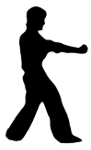
As the primary means of attack or defence is most commonly the arms, Wing Chun system requires the shoulders to be square-on to the opponent so both arms are equidistant and the centre of mass can be equally applied behind each arm, this creates a triangle or wedge.
The shortest and therefore fastest distance of travel between two points is a straight line. A straight line therefore represents economy of motion. This is the line Wing Chun uses to either deliver, intercept or manage an incoming force.
Like when you use an an axe to split wood: the force is delivered and deflected along the sides of the axe head (or wedge) and is concentrated toward the leading edge. When the axe-head strikes the wood all of its mass is concentrated behind the smallest area and when it is accelerated it will penetrate and split even a big block of wood with ease.
To make this work in Wing Chun, both of your arms and your leading leg need to maintain proper structure. Your hand or foot must project along the centre line (leading edge of the axe-head) whilst keeping the elbows within the width of the shoulders - the emphasis of the first and most important section of Siu nim tao.
In attack: force is generated and directed from the centre of mass, along the centreline, out of the arm/leg and into the centre-line or core of an opponent; driving the 'wedge' forward.
In defence: an incoming force is intercepted and channelled away from your centre of mass along the outside of your body 'wedge' structure while maintaining a line of attack into the opponent’s centre-line. To avoid using strength-against-strength, forward motion toward the opponents’ centre-line is required to ‘drive the wedge’ and divert the incoming force.
For more information check out our other articles
- Log in to post comments